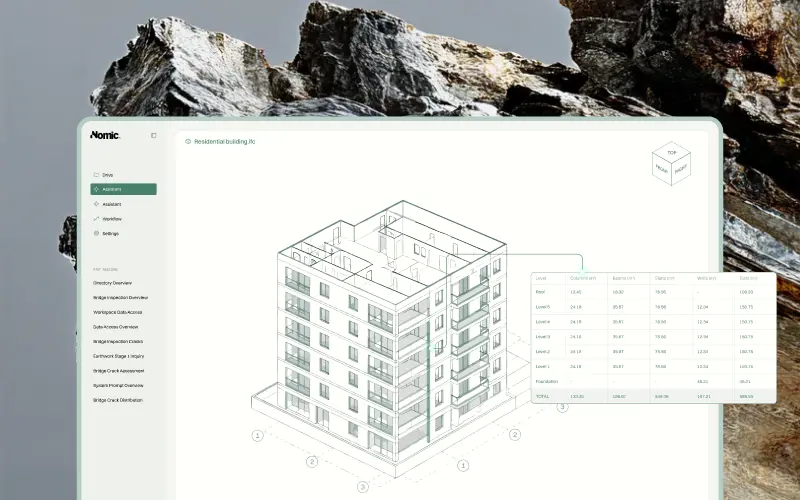
Announcing Nomic's strategic funding round and partnerships with Aurecon and Arcadis

Announcing Nomic's strategic funding round and partnerships with Aurecon and Arcadis

NEWSSeptember 3, 2026

Today, I'm excited to announce that two leading engineering and design companies are now strategic investors in Nomic and long-term commercial partners. Together, we will sharpen and shape how AI agents work alongside the people who design, engineer, and construct the built environment.

Asia Pacific engineering consultancy Aurecon is scaling access to Nomic’s AI platform across its 6,700-strong workforce, following a four-year partnership that helped shape the platform and its application to engineering and project delivery.

Global design and consultancy firm Arcadis is embedding Nomic’s AI agents into the heart of its project-delivery model, following a six-month trial with around 150 engineers across 12 countries.

This is an important milestone for Nomic, but it also represents something larger: a growing conviction among the world's leading firms that AI will fundamentally change how physical assets are delivered.

Only 50 years ago, the floor of the average design and engineering firm was filled with large drafting tables and pencil-lead-stained experts. The invention of CAD, and later BIM and digital collaboration software, transformed that work. It digitized drawings, created systems of record, and made decades of firm knowledge easier to reuse across projects.

Now, a new frontier is here. Machines will no longer just digitize paper, organize files, or record what people have already done. They will increasingly automate meaningful portions of the work themselves, working alongside the experts who direct them.

At Nomic, we believe AI agents will become a new source of capacity across architecture, engineering, construction, and operations.

But the industry is right to be skeptical. Fifty years of digitization, and years of unfulfilled promises around BIM and productivity, have left a sour taste in the mouths of many industry veterans. Software spending continues to rise, while the promised efficiency gains often fail to materialize.

We believe AI agents are different. But only when they are built and deployed around the realities of the industry.

AI should give experts more time to be experts

Most architects and engineers did not spend years in school because they dreamed of reviewing submittals, searching through specification sections, reconciling document revisions, or copying information between disconnected systems. They did it because they wanted to design, solve difficult problems, and build things that matter.

AI should not attempt to remove expert judgment or creative thinking from the process. It should remove the repetitive work that keeps experts from exercising it.

The best AI agents will make an experienced architect, engineer, contractor, or owner dramatically more effective. They will help teams investigate more alternatives, catch more mistakes, respond faster, and preserve institutional knowledge that would otherwise disappear across inboxes, file systems, and project turnover.

AI must understand the economics and risk of projects

AI is open-ended by nature: there is always another question to ask, another option to explore, another analysis to run. Projects are not. They operate within strict budgets, schedules, contractual responsibilities, quality standards, and risk tolerances. A workflow that makes sense on a billion-dollar infrastructure program may be completely inappropriate for a small commercial renovation.

For AI to accelerate the design, engineering, construction, and operation of physical assets, the platform that directs and supervises AI agents must conform to these realities. It must understand project permissions, approved sources, cost limits, review thresholds, deliverable requirements, and the boundary between work that can be automated and work that requires accountable human approval.

This is what we build at Nomic.

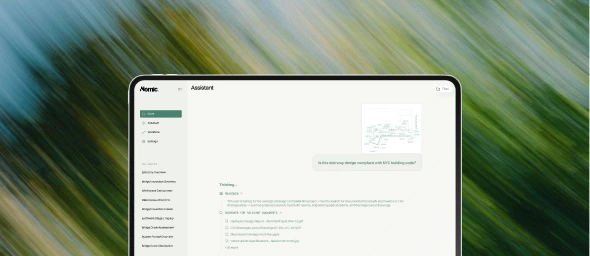
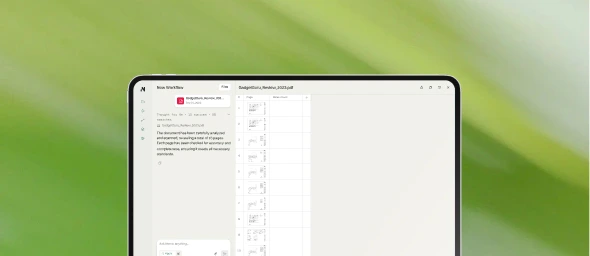
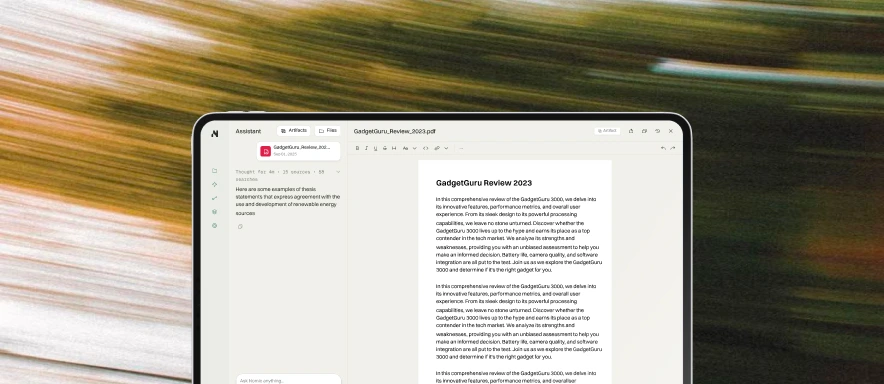
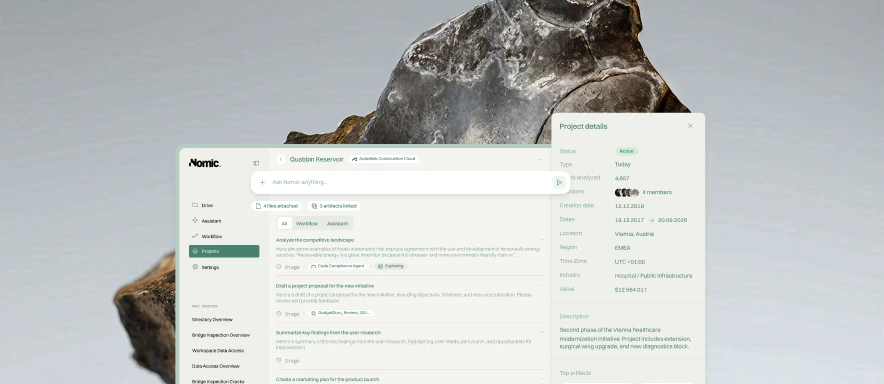
Nomic is the domain-specific AI platform for the built environment. Firms use Nomic to deploy AI agents across their documents, drawings, models, standards and systems to help review drawings against firm standards, check code compliance, take a first pass at submittals, research RFIs, and answer complex questions with traceable, cited results. These agents are deployed inside tools that firms already use, with employees maintaining controls required to operate inside real project environments.

Nomic Agent Task Distribution

The jobs and skills our agent is built to perform across the built environment. Click a category to go deeper.

v1.0.0 · 187 tasks

EngineeringArchitectureAgent capabilityConstructionOperationsConstruction administration19 tasksDesign17 tasksStrategy & pursuit12 tasksFeasibility & planning12 tasksCommissioning & closeout10 tasksIn-serviceoperations7 tasksDisciplinedesign6 tasksStudies &analysis5 tasksConstructi…phaseengineering4 tasksConstruction administration19 tasksDesign17 tasksStrategy & pursuit12 tasksFeasibility & planning12 tasksCommissioning &closeout10 tasksIn-serviceoperations7 tasksCodes & standards14 tasksPDFannotation5 tasksBIMmodeling5 tasksCADdrafting4 tasksTakeoff4 tasksMeasureme…4 tasksGroundi…4 tasksVisualread4 tasksArtifactproduction4 tasksInt…2Preconstruction12 tasksConstructionoperations11 tasksClos…4Capital program5 tasksOwner oversight4 tasksOccupancy &facilities4 tasksDelivery-teamprocurement3 tasks
  • Architecture
  • Engineering
  • Construction
  • Operations
  • Agent capability
AI adoption is an operating-model change, not a software rollout

AI agents are not analogous to the software that firms purchased and operationalized during the 2010s. Traditional software generally introduced a defined tool with a relatively stable set of features. AI introduces a capability that expands every month.

That creates a new organizational challenge. Every firm will need to decide where agents can act independently, where they should assist, where expert review is mandatory, how output quality is measured, and how new capabilities are introduced safely across thousands of employees and projects.

Technology alone will not solve this. Successful adoption requires hands-on implementation, training, workflow design, governance, measurement, and ongoing support for staff working at the constantly evolving line between human judgment and machine decision-making.

This is what our implementation and onboarding teams do at Nomic. We work with firms not simply to provide access to AI models, but to identify valuable workflows together, operationalize them, train teams, measure performance, and expand usage responsibly.

The future will be built on an open and neutral intelligence layer

The built environment is fragmented across disciplines, project participants, software vendors, file formats, and contractual lines. No single application owns the entire project lifecycle, and no serious firm should have to surrender its data, workflows, or operating model to one closed ecosystem in order to benefit from AI.

At Nomic, we remain committed to being a neutral platform serving the entire built environment. We are building an intelligence layer that works across the systems firms already use and the information they already possess: drawings, specifications, BIM models, contracts, standards, correspondence, schedules, submittals, and decades of proprietary institutional knowledge. We are building AI that understands engineering and construction, not generic AI adapted to it.

Our goal is not to replace the systems of record that run the industry. Our goal is to put the knowledge inside them to work, and to give every project team AI agents that can reason across that knowledge and carry real work forward, with expert review wherever it matters.

Where we are going

The next generation of architecture, engineering, and construction firms will run on intelligence, not just information. They will operate differently from the firms of the past. Their best practices will not live only in the memories of a small number of senior employees. Their teams will not repeatedly solve the same problems from scratch. Their most experienced people will not spend their time searching, checking, formatting, and coordinating. AI agents will instead work alongside people to share and connect information, beyond singular projects.

Our partnerships with Aurecon and Arcadis bring us closer to that future. They give Nomic the opportunity to build alongside firms operating at extraordinary scale, across some of the most complex projects and consequential infrastructure in the world. We have already seen what this looks like in practice: in a six-month trial with around 150 Arcadis engineers across 12 countries, 86% said Nomic changed how they approach their work. Their experience will help us establish the workflows, controls, and standards required for agents to become a dependable part of professional practice.

Together, we believe AI won't replace architects and engineers. It will amplify them, unlocking the expertise inside every firm by reducing repetitive work, improving quality, and giving teams more time for the problems only they can solve.

We are proud of what Nomic has accomplished so far, but we are still at the beginning. The integration of agents into engineering and design practice will be one of the most important technological shifts the built environment has experienced. Nomic intends to be the platform on which that transition is built.

We are grateful to our customers, partners, and investors for their trust and collaboration in getting us here. The next era of the built environment is taking shape, and we're excited to build it together.

If you'd like to see what Nomic's agents can do on your own projects, we'd love to show you. Book a demo or learn more at nomic.ai.

Andriy
CEO

Share this article:

Related Articles

Out-of-the-box workflows on the platform

From code compliance to drawing review and project research—automate critical AEC workflows using your drawings, specs, and project data.

Automated Code Compliance of Drawings

Automated Code Compliance of Drawings

Check drawings against 380+ building codes and standards anywhere you work in Nomic—Assistant chat, workflows, the workflow builder, and the API. Get cited answers with specific code references—no more digging through PDFs and standards manuals.

Automated Drawing Review

Automated Drawing Review

Catch errors in construction drawings and plans before they become costly rework. Nomic's Drawing Review agent checks every page of a drawing set or plan package against your firm's QA/QC standards, delivers cited PDF markups, and can send validated findings back to Autodesk Forma, Fieldwire, and Bentley ProjectWise as native issues.

Automated Submittal Review

Automated Submittal Review

Automate submittal review with AI that cross-references every package against your drawings and specs—and generate the project's starting submittal log from the full project manual. Nomic handles first-pass review and log setup so your team focuses on decisions, not document triage.

Firm-Wide Detail Search

Firm-Wide Detail Search

Give designers instant access to every detail your firm has ever drawn. Powered by Nomic Parse, search across thousands of drawings to find the exact detail you need—without digging through folder after folder.

Project Research

Project Research

Instantly access project-critical information—drawings, specs, RFIs, and project documents—from a single research interface, and anticipate the RFIs that drawings and specs will generate before they hit the field.

AI for BIM & IFC Models

AI for BIM & IFC Models

Solve real tasks in your IFC and BIM models — without Revit, Navisworks, or a BIM specialist. The Nomic agent reads IFC files natively, extracts the full model into queryable tables, and runs quantity takeoffs, coordination checks, data validation, and space schedules on demand.

Nomic agents work in your project delivery software and tools
SharePoint
Egnyte
Autodesk Construction Cloud
ProjectWise (Bentley)
Trimble ProjectSight
Fieldwire
Google Drive
Box
Dropbox
Microsoft Teams
Outlook
Gmail