Wisconsin Built Sets a New Standard for Drawing Review and Project Intelligence
Wisconsin Built ran Nomic on a historical job so estimators and project managers could catch missed issues in their own process.
- CompanyWisconsin Built
- Size200+ employees
- HeadquartersDeerfield, Wisconsin

$17k
Loss identified on a past job
20
High-priority RFIs flagged
47 hrs → 18 min
Scope extraction, time compressed
“The job that we gave you guys unbeknownst to you was the job that we lost money on. And it passed exceptionally well and caught it. And that was about 17,000 dollars that we lost in that job.”
Challenge
Wisconsin Built is a general contractor whose work includes millwork and casework. Margin leaks on past jobs were hard to see until after the work was done. On the Food + Farm Exploration Center job, they already knew they had lost money, and they needed a way to test whether an AI-assisted review of the drawings and shop set would have caught what their original assessment missed.
Estimators and project managers needed that review inside their own process. Another manual review of the project would not change how the next package got bid or handed off.
Approach
Jean Delonget, Wisconsin Built's IT Administrator, ran Nomic on that historical job without telling the Nomic team it was a known loss. The instance was loaded with the architectural drawing set, Architectural Woodwork Standards (second edition), and the shop drawings for the package.
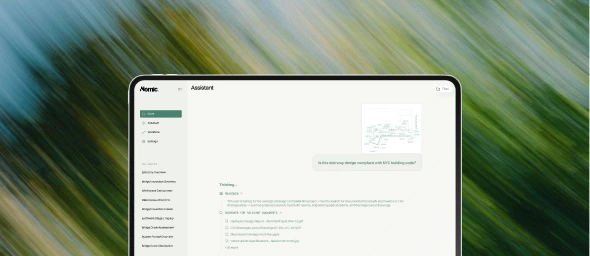
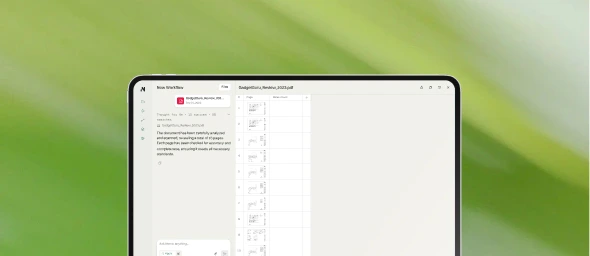
Nomic workflows ran in phases over those files: scope extraction (owned by estimating) with an RFI log cross-referenced to drawings and woodwork standards, then shop drawing assessment and submittal review (owned by project management) against the same architectural set and woodwork standards. Outputs included a drawing checklist and a redline report with marked-up sheets and issues grouped by category and severity. Estimators and PMs could work from them directly, not as a parallel side process.
Outcome
Nomic caught the issues on the job Wisconsin Built had already lost money on. Jean treated that catch as the deciding proof for moving ahead.
Nomic's scope-extraction workflow tied the RFI log it generated to specific sheets and the woodwork standards, giving estimators a direct line from each flagged item back to the drawing that raised it. That traceability is what let the team compare Nomic's findings against the original bid and see exactly where the estimate had missed the mark.
The same pass flagged 20 high-priority RFIs on that package before fabrication. Scope extraction that used to take an estimator about 47 hours came back from Nomic in 18 minutes, a roughly 158-to-one time compression.
“The compression rate was like 158 to one in comparison, which is pretty remarkable. And that’s what everybody loved.”
See how Nomic can work for you
Start for free and run the same workflows on your own project files.
Start for freeExplore Nomic
Nomic Platform
Domain-specific AI agents that accelerate AEC workflows across drawings, specs, and project data
Agent API
AEC-trained models for document parsing, embeddings, and intelligent search
Use Cases
AI workflows for code compliance, drawing review, submittal review, and project research