Code compliance reviews are a familiar part of AEC delivery, and yet they remain one of the most time-consuming and unpredictable workflows of a project.
On paper, the process is straightforward. Drawings are reviewed against applicable codes, issues are identified, and compliance is confirmed. In practice, the complexity doesn’t sit in the regulations themselves. It sits in how information is embedded across drawing sets, particularly in construction details.
These details are where design intent, buildability, and regulation intersect. They are also where reviews slow down most. What often goes unaddressed in conversations about code compliance is that most tools are built around the wrong assumption: that compliance happens once, on a complete and final drawing set. In reality, code checks happen continuously, from the earliest design ideas through to delivery.
The inability of existing products to work with partial, evolving, or informal inputs, early screenshots, incomplete packages, interim revisions, creates a fundamental gap. It forces teams to delay meaningful compliance checks until late in the process, when changes are more expensive and harder to absorb. That limitation isn’t a minor feature gap; it’s a structural deficiency that runs counter to how projects are actually designed and delivered.
The Hidden Time Sink in Code Compliance: Rebuilding Context
What consistently stretches compliance reviews isn’t judgement. It’s context-building. Engineers spend hours locating small but critical details, cross-referencing annotations across multiple sheets, checking consistency between drawings, and reconstructing intent from fragmented information. Much of this effort is repeated from project to project, but across every stage of the same project as designs evolve.
Construction details are often scattered across large drawing sets. Many live in scanned or legacy files. Others are compressed, revised, or detached from the context that gives them meaning. As a result, reviewers are forced into constant context-switching, zooming, scrolling, cross-checking, and second-guessing before a meaningful assessment can even begin.This is where compliance reviews quietly absorb days instead of hours.
Can AI Automate Code Compliance of Drawings?
It’s no surprise that firms have looked to AI to relieve some of this pressure. But most tools available today weren’t built for the reality of AEC drawings.
General-purpose AI tends to treat drawings as static images. Large, poster-scale sheets are resized to fit a model. Fine text becomes unreadable. Visual relationships flatten. Construction details, the very elements that carry compliance risk, lose fidelity.
For workflows that depend on visual clarity and contextual understanding, this loss of detail isn’t a minor limitation. It undermines trust. As a result, many teams try traditional AI tools once, find it unreliable, and return to manual reviews, not because the process works well, but because it’s the only option that feels safe.
</br>
Why Code Compliance Has Stayed Manual
Code compliance of drawings isn’t a document search problem. It’s a visual understanding problem. Compliance decisions depend on interpreting construction details embedded across large, multimodal drawing sets, where linework, annotations, tables, symbols, and references only make sense when read together. Until drawings could be read and structured at full fidelity, automation simply wasn’t viable.
That’s why this workflow has resisted change for so long. Without a way to reliably interpret drawings as engineers do, technology could only sit on the sidelines.
A Shift in How Drawings Are Treated
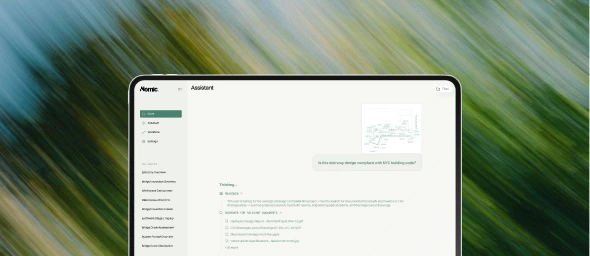
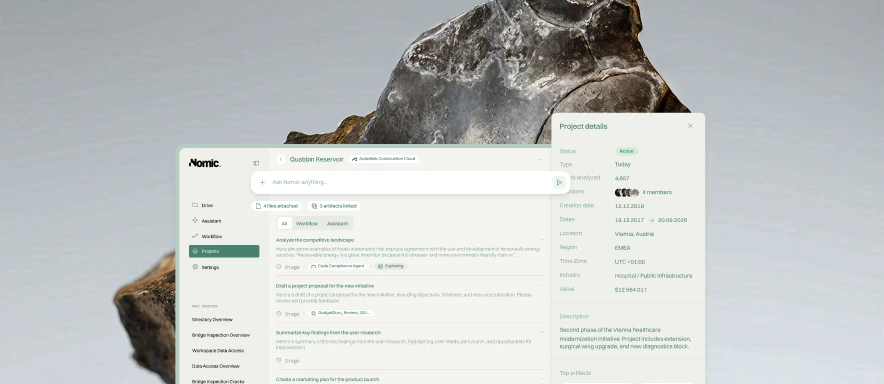
One emerging approach is to stop treating drawings as images to be analysed and start treating them as primary sources of structured information.Nomic is built around this idea. Its parsing models are designed specifically for large, multimodal AEC drawing sets, preserving full drawing fidelity rather than compressing sheets to fit a generic model. Drawings are processed at native resolution, allowing construction details, annotations, callouts, and references to be interpreted together, even across scanned and legacy files.
The significance of this isn’t automation for its own sake. It’s the ability to reduce the manual effort required to extract information before a review can even begin.
What Changes When Details Become Reviewable
When construction details can be read, structured, and assessed directly within the drawing set, the nature of the compliance review shifts.
Instead of starting with document hunting, engineers start with context. Construction details, annotations, schedules, and references are no longer scattered across compressed sheets or buried in legacy files, they are accessible in relation to one another, exactly where compliance decisions are made.
This has a measurable effect on how long reviews take and how teams work. According to observed workflows, detailed code compliance checks that traditionally require around 16 hours of manual effort can be reduced to approximately 4 hours when drawings and details are parsed at full fidelity, a 75% reduction in review time. That time saving doesn’t come from skipping steps. It comes from removing the need to manually extract, cross-reference, and reconstruct information before the review can begin.
As a result:
- Engineers spend more time assessing compliance and less time locating information
- Senior reviewers are pulled in less frequently to help interpret or find details
- Issues are identified earlier, reducing late-stage rework
- Compliance decisions are easier to trace back to specific drawing details and code references
In other words, when details become reviewable, compliance becomes more consistent and repeatable, not faster at the expense of rigour, but faster because the groundwork no longer has to be rebuilt each time.
This is the practical shift behind the code compliance of drawings use case: enabling teams to work directly with the information that compliance depends on, rather than spending hours assembling it first.
Why This Matters Now
This matters now because projects are becoming more iterative, not more linear, yet many compliance tools are still built for a world where checks only happen at the end, on finished drawings.
As projects grow more complex and teams more distributed, the traditional way of handling code compliance becomes harder to sustain. Reviews depend heavily on individual experience, institutional knowledge that isn’t easily shared, and manual effort that doesn’t scale.
The challenge isn’t a lack of expertise. It’s that critical information is locked inside drawings in ways that technology has historically struggled to interpret.
Approaches that can finally work at drawing scale, without sacrificing fidelity, point toward a future where compliance reviews are faster, more consistent, and less dependent on who happens to remember what.
Not by replacing professional judgement. But by making the information judgement depends on easier to work with.
Want to know how we can help reduce friction in compliance reviews without compromising rigour?
Learn more here:https://www.nomic.ai/use-cases/code-compliance-of-drawings