2025 will be remembered as the year AI went from a conversation topic to a deployment reality in architecture, engineering, and construction. While AI adoption in AEC has lagged other industries for years — constrained by data complexity, regulatory requirements, and a workforce accustomed to analog processes — this year marked a genuine inflection point.
Here is our look back at the trends, investments, and milestones that defined AI in the built world in 2025.
Record Capital Flowed into AEC AI
The funding numbers tell the story. PermitFlow raised $54M to automate the permitting process. Bobyard raised $35M to scale AI-powered takeoffs. Attentive.ai secured $30.5M for AI estimating. Unlimited Industries raised $12M for infrastructure preconstruction. LeanCon raised $6M promising seven-minute preconstruction plans.
And the biggest headline: AECOM's $390M acquisition of Norwegian startup Consigli, signaling that major industry incumbents are choosing to buy AI capabilities rather than build them in-house.
These investments are concentrated in a few key areas: preconstruction workflows, code compliance and permitting, drawing review, and estimating. The common thread is that investors and operators alike recognize that the front-end knowledge work in construction — the part that happens before a shovel hits the ground — is ripe for AI transformation.
Code Compliance Became a Product Category
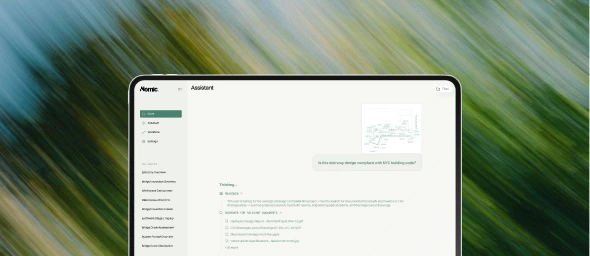
One of the most notable developments in 2025 was the emergence of AI-powered code compliance as a distinct product category. UpCodes launched its Copilot Intelligence with 93% accuracy on building code queries. Buildcheck raised $5.9M for automated design review, with customers reporting 10-35x ROI. And at Nomic, we expanded our platform's code compliance capabilities to cover over 380 building codes and standards.
The convergence of better document AI, more capable language models, and growing digitization of code content has made it possible to build tools that can meaningfully assist with code compliance — a task that was considered too complex for automation just a few years ago.
Robotics Moved from Demos to Deployments
Construction robotics had its best year yet, with companies moving from proof-of-concept demonstrations to real jobsite deployments. Bedrock Robotics proved out autonomous excavation on a 130-acre energy project, moving over 65,000 cubic yards of earth. Buildroid brought its multi-robot masonry system to U.S. sites. Okibo launched a drywall finishing robot that operates autonomously at 24-foot heights.
Market forecasts now project the construction robotics market growing from $1.3B in 2026 to $11.1B by 2040, and standards bodies like ASTM International have begun writing safety standards for construction robots — a clear signal that the industry expects large-scale deployment.
The Data Center Boom Accelerated Everything
The explosion in AI infrastructure investment had a direct impact on the construction industry. Data center projects drove significant construction volume throughout 2025, creating demand for faster design, more efficient preconstruction, and higher-quality construction delivery. The irony is not lost on us — the AI infrastructure boom is itself a catalyst for AI adoption in the construction industry building that infrastructure.
The Adoption Gap Persisted — But Narrowed
Industry surveys painted a mixed but improving picture. Dodge Construction Network found that 87% of contractors believe AI will transform their business, but only 19% have adapted their workflows. The Bluebeam-ASCE survey found only 27% of AEC professionals currently use AI, with 52% still using paper during design. Yet among current AI users, 94% plan to increase their use in 2026.
The gap between awareness and adoption is real, but it is closing. The early adopters are reporting strong results — automated proposal generation rated 92% effective, contract risk review at 86% — and their success stories are creating momentum for broader adoption.
What It Means for 2026
The foundation has been laid. The technology works. The investment is flowing. The early adopters are proving the value. 2026 will be the year that AI adoption in AEC shifts from early-adopter territory into the early majority.
The firms that started their AI journey in 2025 will have a meaningful head start. Those that start in 2026 can still catch up. But waiting much longer risks falling behind an industry that is finally, decisively, moving toward AI-powered workflows.
At Nomic, we are excited to be part of this transformation. Book a demo to see how our platform can help your firm stay ahead.